

Why do we cling so tightly to what we already have? So tightly that we refuse to exchange it for its fair market value? This question has fascinated economists for decades, and the most influential answer emerged in the 1980s with the rise of behavioral economics. The concept that captured this phenomenon became known as the endowment effect.
Where the Endowment Effect came from
The term was introduced by Richard Thaler and later formalized through experiments conducted with Daniel Kahneman and Jack Knetsch. Their goal was to understand why people assign higher value to objects simply because they own them.
Two early experiments became foundational:
1. The Mug Experiment (Knetsch & Kahneman, 1990)
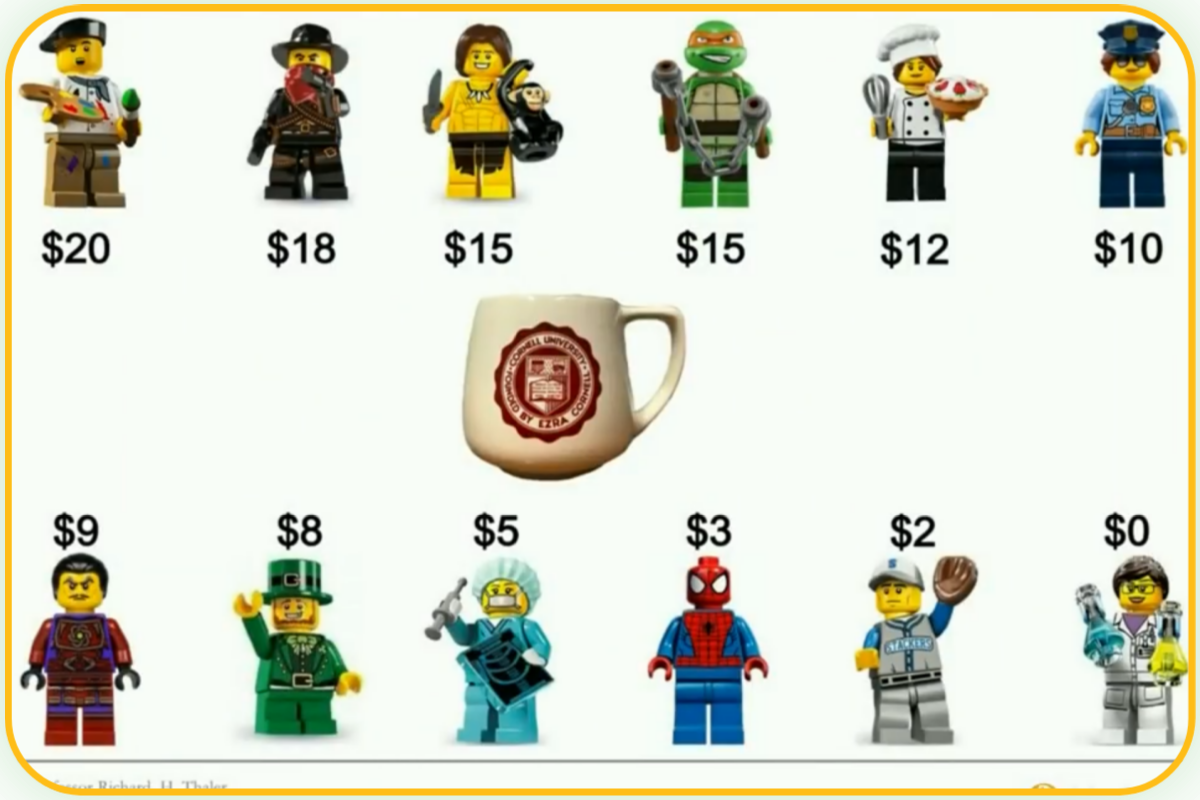
Participants were randomly given a coffee mug. Later, they were asked either:
- how much they would sell the mug for (sellers), or
- how much they would pay to buy one (buyers).
The result:
Sellers demanded roughly twice as much as buyers were willing to pay.
2. The Pen vs. Mug Choice Experiment
Participants were given a mug and later offered the chance to trade it for an equally priced pen.
Most refused to trade, even though they had shown no preference before receiving the mug.
These experiments led to three major psychological explanations:
Loss Aversion
Losing something we own feels more painful than gaining something of equal value feels good.
In other words: the pain of losing the mug outweighs the pleasure of gaining money for it.
Status Quo Bias
We prefer things to stay as they are.
Ownership becomes the default, and changing the default feels costly, even when it shouldn’t.
The Endowment Effect
Ownership itself inflates perceived value.
Once something becomes “mine,” it becomes part of my identity, and giving it up feels like giving up a piece of myself.
Together, these biases seemed to explain why we overvalue what we own.
My personal add‑on: the Hidden Replacement‑Cost Bias
Transaction Cost Theory (TCT), developed by Ronald Coase and Oliver Williamson, argues that every exchange has hidden costs:
- searching for alternatives
- negotiating
- monitoring
- replacing
- switching
People avoid transactions when these costs are high.
My view is that when someone does not know exactly what those costs might be, or is not willing to take them on, they tend to assign a higher price to the item. They do this because they want to avoid the possibility of having to replace it later at their own expense. Even if they initially believed they did not want the object, once they have it, they may start imagining potential uses for it and become reluctant to give it up without compensation for the effort of getting another one.
Again, this should be understood as an additional hypothesis of mine. I propose that people may also be factoring in the future cost of replacing an item when deciding whether to give it up.
If someone receives a mug and likes it, even a little, they may think:
- “If I sell this and later want one, I’ll have to go find it again.”
- “I don’t want the hassle of replacing it.”
- “Selling it for the same price doesn’t compensate me for the effort of getting another.”
This introduces a hidden cost that the original researchers may have overlooked.

So, the endowment effect may not be purely irrational.
It may be partly a rational response to:
- search costs
- time costs
- effort costs
- uncertainty about finding a replacement
- fear of regret
How this shows up in Work and Career
The endowment effect and our tendency to hold on to what we already have are not limited to mugs and pens. They deeply influence professional life as well.
1. Staying in comfortable roles
People often avoid pursuing more challenging career paths because:
- they fear losing their current status
- they fear losing their current salary
- they fear losing the familiarity of their routine
Even when the new path offers higher long‑term rewards, the “loss” of what they currently have feels too heavy.
2. Avoiding skill development
Learning new skills requires:
- time
- effort
- uncertainty
- temporary incompetence
Many professionals cling to their existing skill set because they “own” it.
They overvalue what they already know and undervalue what they could learn.
3. Rejecting better opportunities
People sometimes decline promotions, new roles, or lateral moves because they perceive:
- more work
- more responsibility
- more risk
Even when the opportunity is objectively beneficial, the psychological cost of giving up the current situation feels too high.

Long‑Term Consequences
Over time, this leads to:
- stagnation
- reduced earning potential
- lower adaptability
- decreased confidence
- missed opportunities for growth
The endowment effect in career decisions can quietly shape an entire professional life.
What reduces the perceived value of what we own to the point where we are willing to trade it?
There are many everyday situations that show how strongly we tend to stick to what we already have. People often keep clothes they no longer wear simply because they are already in the closet. They hold on to old phones long after better models are available because the familiar device feels safer. They stay in jobs that no longer challenge them because the current role feels known and predictable. They keep subscriptions they barely use because canceling feels like losing something they already paid for. These examples illustrate how ownership creates a sense of comfort that makes letting go feel more costly than it actually is.
But behavior is a tricky thing, and the endowment effect does not always take place. There are situations in which people do not stick to what they already have, and these exceptions allow us to learn from the underlying nuances of the effect. By understanding when the bias weakens, we can use those insights to reduce its influence in other situations where it holds us back.
1. The Effect shrinks in real markets
Experienced traders, such as sports card dealers, show little or no endowment effect. They know the true market value of their items and understand how easily they can replace them.
2. The Effect depends on uncertainty
When people don’t know the real value of an item, they overvalue what they own. When value is clear, the effect weakens.
3. The Effect depends on market frictions
When replacement is easy, cheap, and fast, the endowment effect becomes smaller.
This suggests that expertise in a trading environment can significantly reduce the bias of holding on to what one already owns. With experience, people begin to place the sense of security not in the object itself but in the trade system they operate in. The utility shifts from ownership to the confidence that the item can be reacquired whenever needed.

How to overcome this Bias in your Career
Here are practical strategies to loosen your grip on what you “own” and open space for growth.
1. Reframe Loss as Investment
To reframe loss as an investment, you need to do your due diligence and research. Ask yourself whether there are opportunities you have been blind to. Once you begin to understand your industry, or even other industries, and how they operate and trade, you start seeing possibilities that were invisible before. This includes learning how roles, positions, and paths to getting work function, even for people who are self‑employed. As you gain a clearer sense of how things actually work, and as you talk to people in different positions, you can gradually shift your mindset.
Instead of thinking
“If I leave this role and the habits that come with it, I will lose stability.”
you begin to think
“If I stay the same forever, I will lose important opportunities.”
This shift moves your reference point from what you have now to what you could gain later. It also helps you absorb the transaction costs little by little, rather than feeling forced to take them on all at once.
2. Quantify the Hidden Costs of staying the same
Ask yourself:
- What skills am I not developing?
- What opportunities am I not exploring?
- What income am I not earning in the future?
Staying put also has transaction costs, just invisible ones.
3. Create a “Replacement Fund” of time
Set aside weekly time for:
- learning
- networking
- exploring new roles
- experimenting with new skills
This reduces the psychological cost of switching right from the start because you already have a buffer of preparation.
Final Thought
We value what we own not only because of emotional biases like loss aversion and a preference for the status quo, but also because we may, consciously or not, anticipate the costs of replacing, rebuilding, or re‑earning what we give up. Recognizing this helps us make better decisions, especially in our careers, where clinging to the familiar can quietly limit our growth.
When we learn to loosen our grip, we create space for new skills, new opportunities, and new versions of ourselves that are waiting to emerge.
