

We live in a culture that worships “the smartest guys in the room.” We assume that a high IQ, a prestigious MBA, or a groundbreaking discovery in physics serves as a permanent insurance policy against stupidity.
But history, and a growing body of behavioral science, tells a more disturbing story. From Sir Isaac Newton’s financial ruin to the systemic fraud at Enron, the most catastrophic errors in judgment are often made not by the ignorant, but by the brilliant.
The truth is that intelligence is a tool, not a shield. If used without the right mental frameworks, high intelligence actually makes you better at lying to yourself. It allows you to build sophisticated cathedrals of logic to justify decisions that are fundamentally irrational.
If you want to protect your career, your wealth, and your reputation, you must stop relying on raw brainpower and start training your Mental Operating System.
1. The “Walter White” Effect: When Territory Overpowers the Map
The first great “Thinking Trap” is the belief that character is a fixed, immutable trait. We believe that a “good person” will always make ethical choices, regardless of the pressure.
However, recent research suggests that ethics are highly dependent on the “Territory”—the actual environment we find ourselves in.
In the paper “Breaking Bad: How Health Shocks Prompt Crime” (Peijnenburg et al.), researchers found that a cancer diagnosis increases criminal behavior by an average of 14%. This isn’t a story of people “turning evil”; it is a story of how extreme circumstances recalibrate the human decision-making compass.

When life strikes a “Health Shock,” three things happen to the human brain:
- Economic Rationalization: When your legal income is threatened by illness, the brain shifts from “Growth” to “Survival” mode.
- The Discounting of the Future: In Mental Models Book 1, we discuss the “Discount Rate.” If a person believes their future is shorter, the “cost” of future punishment (like prison) loses its weight. The “Map” of the law no longer matches the “Territory” of their survival.
- Externalities as Collateral: We often view crime as a personal failing. But as the study suggests, it is often a “negative externality” of a failing support system.
The Lesson: Character is a choice, but it is a choice that becomes exponentially more expensive when the environment is hostile. To remain ethical, we must build systems (spouses, savings, support) that prevent us from being backed into a corner where the “rational” choice is a “bad” one.
2. The Newton Paradox: The Failure of “System 1” in Geniuses
In 1720, Sir Isaac Newton was the most famous scientist alive. He had literally solved the mysteries of the universe. Yet, he lost $4 million (in today’s currency) in the South Sea Bubble.
Newton actually sold his shares early for a 100% profit. He was winning. But then he watched his friends—people he likely considered “lesser” minds—get even richer. His System 1 (Fast Thinking) took over. The emotional pain of “missing out” (Social Proof) overrode the System 2 (Slow Thinking) logic of a bubble.
He famously remarked: “I can calculate the motions of heavenly bodies, but not the madness of people.”
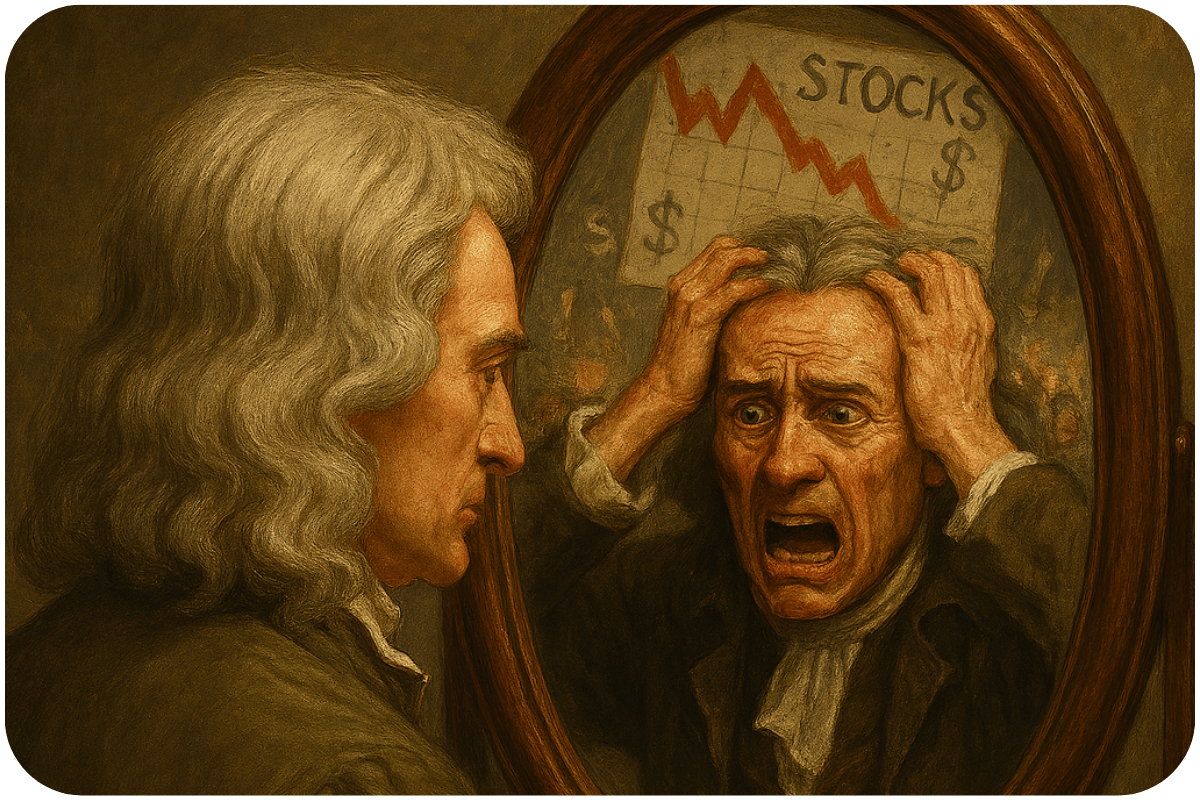
The Newton Trap is twofold:
- Overconfidence: Smart people believe they can “out-think” a crowd. They think they can jump in at the peak and jump out a second before the crash.
- Analogy vs. First Principles: Newton looked at his friends (Analogy) rather than the underlying math of the South Sea Company (First Principles).
Even a genius will fail if they aren’t using the right mental frameworks.
3. Enron and the Danger of Social Proof
If Newton represents individual failure, Enron represents Systemic Failure. Once one of America’s largest energy companies, Enron collapsed into bankruptcy in 2001 after it was revealed that its leadership used systemic accounting fraud to hide billions in debt. It wasn’t a company filled with “born criminals,” but with elite, high-achieving professionals from the world’s top universities.
This environment created a toxic version of Social Proof.

In Book 2, soon to be released, we´ll analyze how feedback loops create “Normalcy.” At Enron:
- Deception became the industry standard. If everyone you respect is “bending the rules,” your brain stops labeling it as “fraud.” It labels it as “innovation.”
- The Cost of Non-Conformity: The human brain is biologically wired to fear being the “odd one out.” Standing up to say “this is wrong” triggers the same part of the brain as physical pain.
- Motivated Reasoning: This is where high intelligence becomes a weapon. Instead of seeing the truth, smart people use their IQ to build “complex” reasons why their fraud is actually brilliant business strategy.
This leads to being “Complexly Wrong.” A simple person might realize they are lying. A smart person will invent 400 pages of accounting theory to prove that their lie is actually a “new paradigm.”
Character is a choice you have to make every day, but it’s much harder to make when the “herd” is running in the opposite direction.
4. Why Intelligence Doesn’t Equal Wisdom
There is a fundamental difference between Information and Thinking Tools.
- Information is knowing that a market is in a bubble.
- Thinking Tools (Mental Models) are the psychological anchors that keep you from jumping in anyway.
Smart people often fail because they have high processing power but a low Operating System. They are running high-speed software on a glitchy, emotional motherboard.
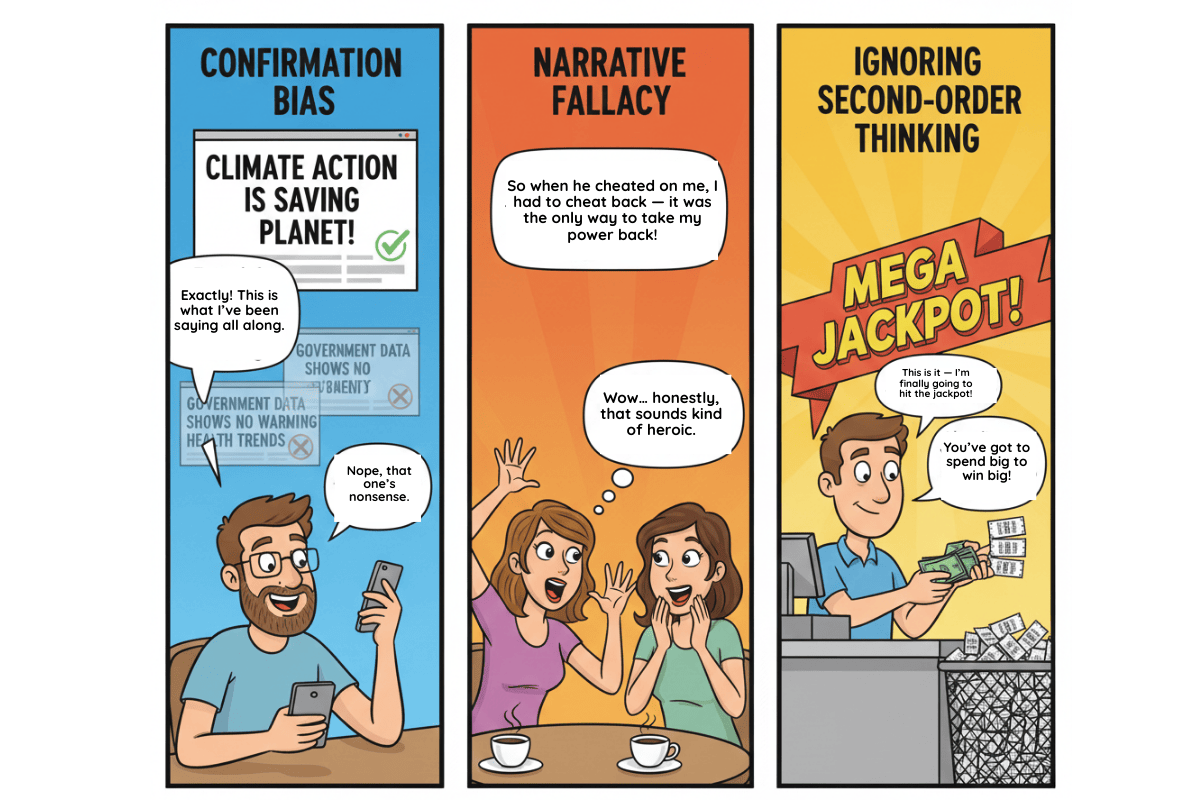
The Most Common “Predictably Bad” Habits of Geniuses:
- Confirmation Bias: Using your intelligence to find reasons why you are already right, rather than looking for why you might be wrong.
- The Narrative Fallacy: Creating a “heroic story” for yourself that justifies a risky or unethical move.
- Ignoring Second-Order Thinking: Focusing on the immediate win (money, status) without calculating the long-term system collapse.
5. Re-Calibrating Your Mind: The 5 Thinking Tools
To avoid the fate of Newton or the Enron executives, you need a set of “Decision Insurance” policies. These are the tools I cover in my upcoming book:
- First Principles Thinking: Break every problem down to its fundamental truths. Don’t do it because “everyone else is.” Do it because the math holds up.
- Second-Order Thinking: Don’t just ask “What happens if I do this?” Ask “And then what happens?” (and what happens after that?).
- Map vs. Territory: Constantly check if your “brilliant plan” (The Map) is actually consistent with the messy, human reality of the world (The Territory).
- Social Proof Audit: Whenever you feel a strong urge to follow a trend, ask: “Would I do this if no one was watching?”
- Inversion: Instead of trying to be “brilliant,” try to be “not stupid.” Map out the pitfalls and close them off.
Conclusion: Will You Be the Hero?
Think about Sherron Watkins, the Enron vice president who eventually blew the whistle. She had to stand alone against a tidal wave of corporate pressure, risking everything to point out the truth while thousands of others stayed silent. Going against the herd isn’t just “doing the right thing”—it’s an act of extreme psychological courage.
Have you ever been in a situation where you had to stand your ground while everyone else was moving the other way?
In the end, character is a choice you have to make every day. But as we’ve seen, it’s a much harder choice when the herd is running in the opposite direction or when the “territory” of your life shifts under your feet.
True intelligence isn’t about how much you know. It’s about knowing how you think. It’s about identifying your “Cognitive Blind Spots” before they lead you toward a predictably bad decision.
The question isn’t whether you are smart. The question is: Is your intelligence working for you—or against you?
Stop Guessing. Start Calibrating.
I’ve designed a 2-minute diagnostic to help you find your specific “Thinking Trap.”
Discover the blind spots holding back your decisions — and how to fix them

A 6‑question assessment that reveals how you make choices under pressure — and what’s holding you back.
Most professionals think they know how they make decisions.
But in complex situations, your instincts can shift — toward logic, speed, risk avoidance, or bias‑driven shortcuts.
This quiz uncovers your dominant decision style, your hybrid tendencies, and the blind spots that quietly shape your choices at work.
You’ll walk away with a clearer understanding of:
- how you process information
- what you prioritize under pressure
- where your judgment is strongest
- where mistakes are most likely to happen
- how to improve your next big decision
Ps. COMING SOON: HOW SMART PEOPLE THINK… and Make Predictably Bad Decisions. A definitive guide on how to stay rational in an irrational world.

