


It’s important to understand that there are three dimensions of reality: how we perceive ourselves, how others perceive us, and how we truly are. Beyond that, individual behavior is swayed by the group, and in a corporate setting, managers’ deeds speak louder than their directives
The corporate environment is full of challenges and opportunities for professional and personal development. Conflicts, often unexpected, can—if well managed—generate valuable insights and strengthen relationships.
This article briefly illustrates a manager’s actions, outlining the considered steps taken to resolve a conflict they experienced with a direct subordinate. From this, you can filter and adapt practical strategies for conflict resolution in your own organizational contexts.
For the purpose of illustrating these steps, let’s call this manager Adam. His approach to conflict resolution, which involved a familiar framework, proved particularly effective in his situation.
Background of the conflict
New to his first leadership position at a new company and with a new project demanding his attention, Adam encountered a highly competent team member who possessed strong technical skills and a proactive attitude. However, a stark contrast in styles emerged: while he valued objectivity and process standardization, his colleague advocated for creativity and flexibility as drivers of innovation. This divergence became evident during the prioritization of the key project, leading to communication breakdowns and a perception of mutual disrespect.

What was Adam´s mental model?
Adam’s mental model at the outset was primarily defined by a strong preference for objectivity and process standardization. He believed that clear, consistent procedures were the best way to achieve efficiency and deliver results, especially in a new leadership role with a new project. His initial approach to management was likely systematic and rule-driven.
However, the conflict with his colleague, and his subsequent self-assessment and empathy exercise, forced an evolution in this model. He realized that an overemphasis on standardization could stifle creativity and flexibility, which were also vital for innovation and team morale. By the end, Adam’s mental model expanded to embrace a more balanced perspective: one where firmness and openness coexist, and where understanding diverse working styles and fostering strong relationships are as crucial as adhering to processes. He learned that flexibility, when strategically integrated, doesn’t compromise efficiency.
Adam navigated the conflict with his direct subordinate through a series of deliberate and structured steps.
Adam’s step-by-step conflict resolution process
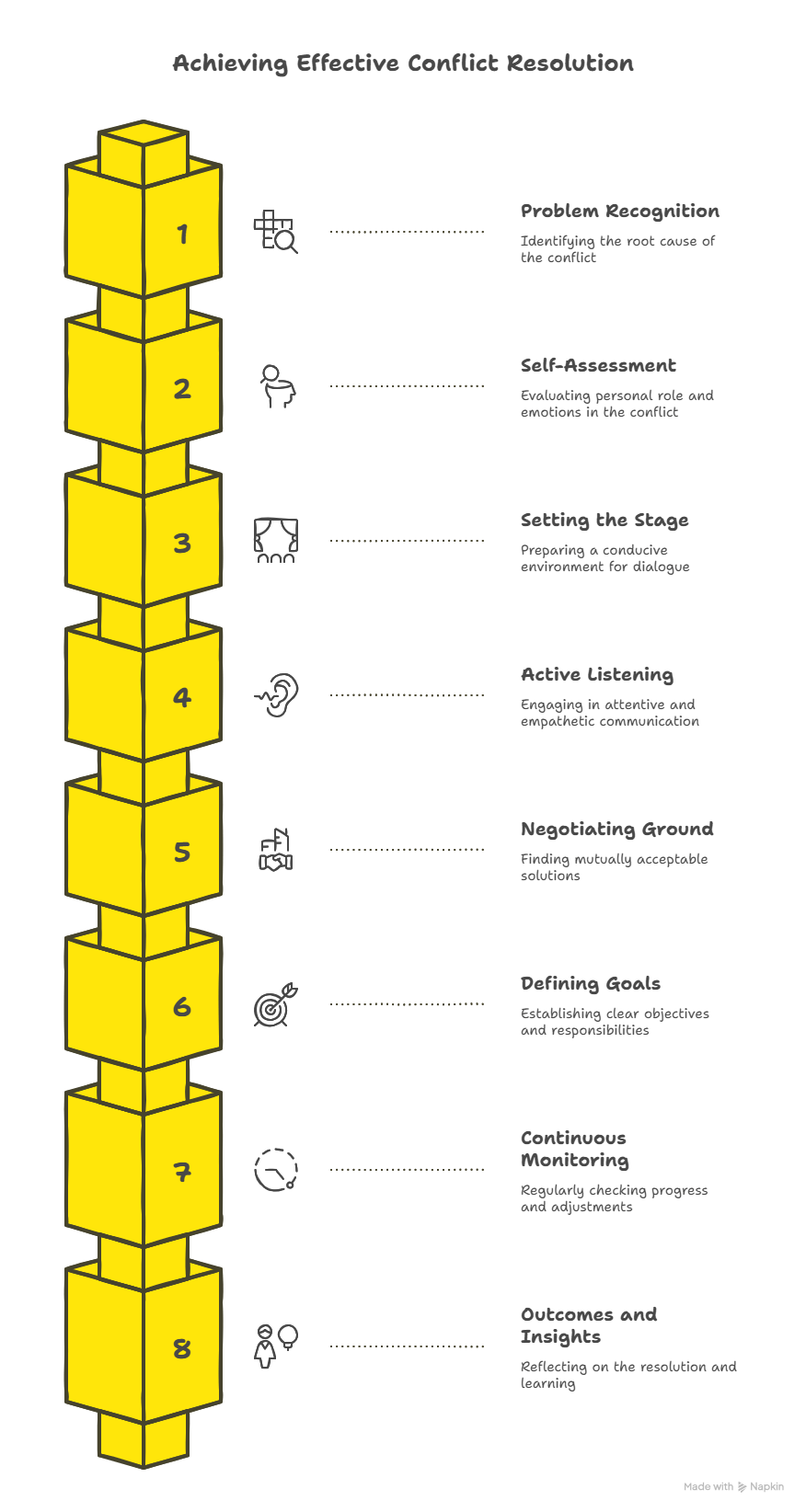
1. Problem recognition

Adam noticed that the friction was negatively impacting team morale and work progress. Instead of ignoring the signs, such as delayed responses and blunt responses, he acknowledged the existence of the problem. This recognition was essential to prevent disengagement and a loss of commitment.
2. Self-assessment and empathy
Before speaking with the team member, Adam critically analyzed his own leadership style, questioning whether his emphasis on standardization might be stifling creativity. He also tried to put himself in her shoes, understanding how she might be feeling unappreciated. This exercise in empathy was crucial for paving the way for dialogue.
3. Setting the stage for dialogue
He then scheduled a one-on-one conversation with her, away from the pressure of daily work. Adam began by acknowledging her strengths and then shared his own motivations, using personal and non-accusatory language. The goal was to demonstrate a willingness to understand and build a solution together.
4. Active listening and constructive feedback

During the conversation, active listening was practiced: open questions, rephrasing what was said, and respecting response time. The difficulties reported were taken into consideration, and in turn, clear feedback was provided regarding deadlines and the impact of processes. The focus was always on outward conduct, not personal judgments.
5. Negotiating common ground

Both parties identified the common objective of delivering quality results. Based on this, a hybrid work model was agreed upon, which maintained necessary standardization but included room for experimentation. The agreement strengthened the partnership and mutual respect.
6. Defining goals and responsibilities

The action plan was formalized with clear goals, realistic deadlines, and shared success criteria. Responsibilities were distributed complementarily: the manager took on monitoring and standardization; the team member, the development of innovative proposals.
7. Continuous monitoring

Weekly checkpoints were instituted for monitoring, exchanging feedback, and making adjustments. In the face of new divergences, the same routine was followed: recognition, listening, negotiation, and recording agreements. This cycle prevented the conflict from recurring.
8. Outcomes and insights

Over time, the culture improved, engagement grew, and deliverables became more consistent. The team member reported feeling more valued. Adam concluded that flexibility, when pre-aligned, does not compromise efficiency. And he learned that leadership requires a balance between firmness and openness.
Conclusion
Conflicts are an inevitable part of working in a corporate environment. However, they can be transformed into opportunities to strengthen relationships and evolve work practices. Some attitudes make a difference:
- Recognize the tension from the outset.
- Reflect on one’s own behavior.
- Practice empathy and active listening.
- Promote frank and respectful dialogues.
- Negotiate solutions based on common goals.
- Establish clear goals and recorded agreements.
- Maintain continuous monitoring.
Finally, it’s essential to recognize that in organizations, example leads the way: managers influence more by what they do than by what they say. Handling conflicts with a mature and structured approach creates room for stronger relationships and more lasting results.
Eager to Learn More Mental Models for Success?


