

You already knew that distractions can reduce productivity both at work and in your personal life. But is the problem really just about turning off your phone, or are you actually underestimating the daily load of information you subject yourself to?
Cell phones are usually at the top of the distraction list, followed by mindless browsing in the browser and on social media. In the background, if you work in person, we can also add gossip, interruptions, noisy colleagues, and too many meetings. All this noise and attention shifting can interfere with your performance more than you realize. Your brain has a daily limit for how much information it can process.

“I can’t get that out of my mind.”
Research on distraction suggests that even small interruptions can increase the chances of making mistakes while performing a task. One key reason is something called attention residue.
You’ve probably experienced this when trying to return your focus to the task you were working on before being interrupted by a coworker with a problem that grabbed your attention. The result? You start checking everything you’ve done again, redoing, rereading, and feeling more exhausted by the end of the day, frustrated by the sense that you haven’t produced enough.
Loss of concentration can occur even in simple tasks, such as in a scientific experiment where participants had to pay attention to a sequence of images and identify whenever a child appeared eating something, and what food it was. The distractions in that experiment were embedded in the task itself in the form of images showing various kinds of food.
Something interesting happened when the participant found one of those “distracting” images particularly interesting: they lost focus and often failed to correctly identify all the images of children eating or what food the child was eating.
Lack of concentration shows up in many ways: fragmented thoughts, slower transitions between tasks, and more mistakes. In other words, it leads to lower productivity and reduced work quality.
The same thing happens to us in everyday life. We may know very well which tasks belong to us, but while executing them we can lose focus even on the task itself—whether because we don’t have everything we need to start, we’re waiting for someone else’s work, or we’re stuck on something that should be discarded, like the images with no children.

“I have no idea how I let something like this slip.”
When we casually say, “I’m processing this information,” we’re not joking.
Your brain processes about 74 GB of information every day, the equivalent of sorting through more than 100,000 emails or sitting in 48 hours of nonstop meetings. Within that bandwidth, conscious processing is much smaller, around 120 bits per second.
Depending on your job, the demand may genuinely push you to prioritize a task that, although not that important within your actual responsibilities, is the one most valued by the company culture or the one people are most eagerly expecting from you. We often do this without fully realizing that we are adopting an automatic mental shortcut driven by the incentive of social reward.
Naturally, our brains try to cope with all the information out there by relying on efficient rules and shortcuts to make quick decisions. These shortcuts are called heuristics and can consistently lead us to flawed conclusions, which we can call cognitive biases.
Just like incentive‑caused bias, other shortcuts end up affecting our judgment in the work environment, leading us to make more mistakes.
These shortcuts appear more or less intensified, and you can notice them in your thinking process:
- Status‑quo bias: Doing things on autopilot, without asking whether the same step‑by‑step approach still applies to the current context—especially when you know you are distracted. Example: Automatically issuing a standard opinion on a request that falls into the wrong category and actually requires a different procedure.
- Confirmation bias: Seeing only what you’re used to seeing—giving more attention to what you already consider “true,” based on your expertise, while downplaying or minimizing signs that you are facing a new situation or case that demands deeper analysis. Example: Only looking for information that concerns you in a group email, without noticing that the task is already being handled by someone else, and ending up starting or completing it, only to realize later that it had already been done.
- Availability bias: Judging something based on how much information you’ve received or currently have in front of you. Example: Giving more weight to promoting the employee who constantly talks about their cases, even though their work always needs review, over the employee who never needs rework but rarely highlights their achievements or challenges.
- Anchoring bias: Strongly anchoring your thinking on a single piece of information or data point, usually the first thing mentioned by colleagues or your manager (such as a deadline, a number, or the first opinion). Example: Focusing on a single negative aspect of a feedback and losing sight of other factors that actually affect the quality of the delivery.
- Recency bias: Giving prominence only to what recently happened around you, and then building your entire procedural reasoning around that. Example: Taking an important decision off the agenda for the following week’s work to deal with something that is neither urgent nor important.
It is not possible to eliminate these shortcuts, but it is reasonable to bring them to the surface whenever you are about to act impulsively, thus reducing substantial mistakes that could otherwise be avoided.
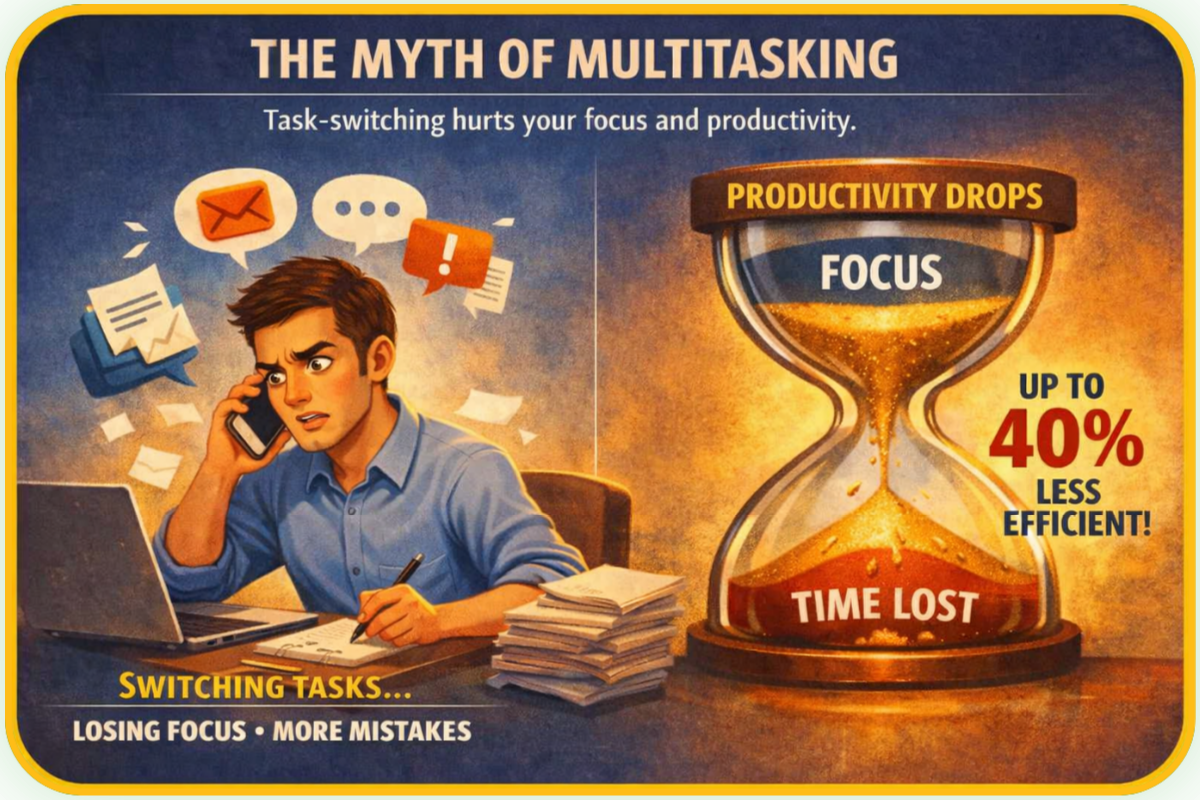
Multitasking doesn’t exist
In terms of human attention, you can fully attend to only one person speaking to you at a time. As soon as someone else starts talking, your brain begins filtering, losing details, and making mistakes.
In other words, what we call multitasking is actually task‑switching—a limit imposed by the brain and made worse by the voluntary use of technology (e.g., checking a message in the middle of a task).
Studies show that productivity can drop by up to 40% when a person tries to alternate between many complex cognitive tasks, because the brain has to partially “reset” its focus with each switch.
It also looks like it takes longer to switch from something familiar to something new than the other way around, our brains struggle more when jumping into an unfamiliar task than when going back to one you already know.
Grouping and Pausing Can Be the Secret
Switching tasks all the time—for example, checking your phone every 10 minutes—can end up hurting you more than you realize. Even though we have the impressive and flexible mental ability to switch quickly between tasks, this “mental expense” has a cost, especially given the sheer number of distractions around you.
Neuroimaging and biochemical studies show that intense mental effort over a long period increases a brain substance (glutamate) that, in excess, disrupts neuron function and signals “lack of energy.” This is perceived as mental fatigue, lowering performance on cognitive tasks and weakening impulse control.
The brain tires and memory can be impaired, which makes it harder for you to reach that long‑term goal.
One thing that can help all of us is task batching and buffer time.

What is task batching?
Task batching (or “grouping similar tasks”) means putting all tasks of the same type into a single block of time instead of switching between them constantly. For example, if you record videos like I do, you can set one block of time only for researching topics, another block only for writing scripts for related themes, and yet another block just for recording.
Adapt this to your situation. In general, most people need specific time blocks for messages and for other repetitive personal and professional tasks. These blocks can range from 25 to 120 minutes, with buffer time in between. Some tasks require more time and focus, such as technical reading and writing, while others require less, such as checking notifications or recording daily expenses.
What is buffer time?
Buffer time is the “protective” time you leave between blocks or tasks: breaks, room for unexpected interruptions, or space to breathe.
You can take 5–15 minute breaks between task blocks (away from screens!)—good ideas that generally apply to most people: going to the bathroom, getting water, doing a breathing exercise with your eyes closed, or taking a short walk.
This buffer reduces the “racing” feeling and protects your working memory, lowering mental fatigue. At the end of the day, you can take a longer pause, for example writing down all pending tasks or worries on a piece of paper to clear your mind.
Facing the flood of information available out there is not easy, and it demands more and more mental energy every day. Distractions are a reality, and learning how to manage them is becoming an increasingly important skill in the job market.
Try to start gradually, being more disciplined with time management and cognitive workload. All of us still have a lot to learn in this journey of developing our minds and making better decisions.
