

Habit stacking, a concept popularized by James Clear in Atomic Habits, is the art of attaching a new behavior to an existing one. The existing habit acts as an anchor. Usually, it’s something you already do automatically. You stack a new habit into that routine.
Here are three simple examples:
- After I brush my teeth, I take my vitamins.
- After I pour my coffee, I open my planner.
- After I end my last meeting, I write down three wins.
Each “after I…” statement turns a moment of indecision into a natural cue.
Why Is Habit Stacking Effective? (And Why Your Brain Loves It)

Habit stacking replaces decision with flow. Every time you ask yourself, “Should I do this now or later?” you use up glucose and willpower. Habit stacking removes that choice. You just do the next linked step.
It creates predictability. Predictable patterns lower anxiety and stabilize attention. Your mind trusts the rhythm and stops wasting energy on “what’s next.”
It builds a kind of compound efficiency. Atomic Habits holds that stacked habits multiply over time. Each small behavior supports the next, turning routine into momentum.
The Deeper Psychological Mechanics
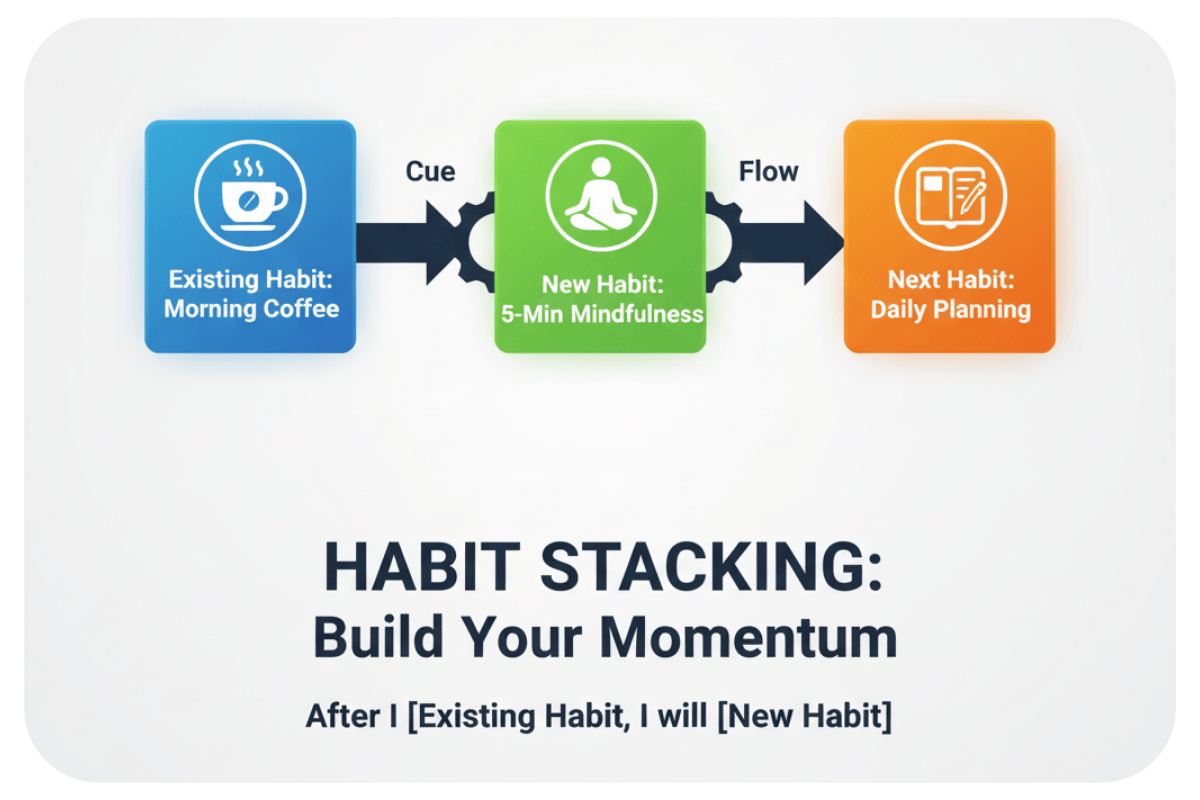
Habit stacking is more than just a scheduling trick; it’s an exercise in applied psychology. You are hacking the brain’s existing system of routine and reward.
The core of every routine lies in the Habit Loop, the sequence of Cue, Craving, Response, and Reward. A new habit struggles because it lacks a defined Cue, your brain doesn’t know when to start it. Habit stacking solves this by hijacking an existing, strong Cue (the anchor habit) to launch the new Response. You are borrowing the “free energy” from a successful habit to initiate the next.
This strategic linkage minimizes the Activation Energy, the mental friction required to go from zero to one. By attaching your new behavior to an existing chain, you are already in motion. The starting line becomes invisible, and the new habit feels less like a choice and more like the inevitable next step. By stacking your actions, you conserve that precious mental energy for the truly important decisions, protecting your focus from the small, repetitive choices that drain your willpower.
Broadening the Application: Stacks for Every Corner of Your Life
Habit stacking is a universal tool for generating momentum. The key is to make the stack context-specific, simple, and relevant to your goals.
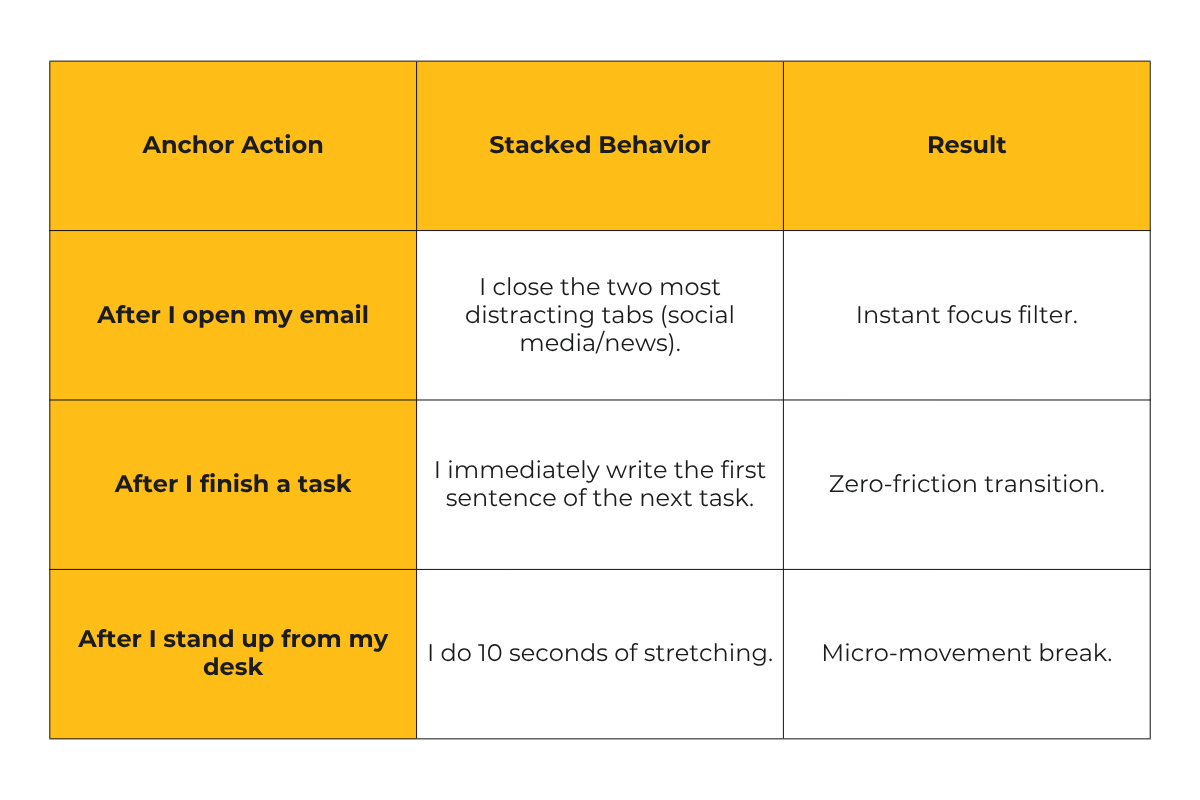
Professional & Deep Work Stacks
These stacks are designed to minimize context switching and protect your focus. They help you transition deliberately between tasks, ensuring your energy is spent on doing the work, not deciding to do the work.
Health & Wellness Stacks

Use your existing daily needs as cues for movement, hydration, and mindfulness, moving beyond simple supplements.
- After I refill my water bottle, I take one deep, 3-second breath. (Couples hydration with mindfulness.)
- After I put my lunch (or dinner) plate in the sink, I do two minutes of countertop stretching. (Adds movement near a mandatory action.)
Connection & Relationship Stacks

Use mandatory daily events to anchor habits that strengthen social bonds, ensuring connection is never an afterthought.
- After I put my phone on the charger for the night, I tell my partner one thing I appreciate about them today.
- After I leave a video call meeting, I send one short, encouraging message to a teammate.
Here is an example for a team leader of a morning habit stack
After I wake up → I drink a full glass of water. After I drink water → I review my top three priorities. After I review priorities → I send one gratitude message to a teammate.
Three small actions, zero mental strain, and the day begins hydrated, focused, and connected.
Troubleshooting: When the stack crumbles
Habit stacking is about momentum, not perfection. You will miss a stack. The victory is not in maintaining a flawless chain; it’s in getting back on track quickly.

1. The Art of the Perfect Anchor
Not all existing habits are good anchors. An effective anchor must be Consistent, Daily, and Precise. Vagueness is the enemy of momentum.
- Bad Anchor: “After work…” (Too vague; ‘work’ ends at different times).
- Good Anchor: “After I power down my work laptop and place it in my bag, I will spend 5 minutes reviewing my notes.” (Specific and undeniable).
2. The Recovery Stack Rule
If you break your chain, introduce a micro-stack to get back on track. Your Recovery Stack is your ultimate act of energy protection.
Recovery Stack Rule: After I remember I missed a stack, I will immediately do the first small step of the habit.
(Example: If you forgot to do your five minutes of journaling, the moment you remember, do it right then. Do not wait for the designated time tomorrow.)
3. Avoiding Over-Stacking
Guard against overwhelm. Do not try to build a chain of ten new habits at once. Start with one new link on a single anchor. Once that link is automatic (usually 2-4 weeks), you can add the next. Stack slowly to build momentum quickly. The goal is automaticity, not exhaustion.
Tracking and The Long-Term Feedback Loop
To make habits stick, you need a feedback loop.
- Track Momentum, Not Outcomes: Don’t track if you wrote a great journal entry; track if you completed the stack. A simple ‘X’ on a calendar for the day you completed the anchor-stack sequence is all you need.
- The Identity Shift: Consistent stacking reinforces a new identity. If you stack ‘After I finish my workout, I log my food,’ you stop thinking of yourself as ‘someone trying to get fit’ and start believing ‘I am a healthy person who finishes what they start.’ The habit reinforces the belief, and the belief reinforces the habit.
- The Quarterly Stack Audit: Every 90 days, review your chains. Ask yourself: Is the anchor habit still working? Can a stacked habit now become a new anchor? What started as “After I pour coffee, I open my planner” may now be so automatic that you can turn the planner-opening into an anchor for the next thing: “After I open my planner, I jot down three ideas for the day.”
The Habit Stacking Workshop: Design your chains
Decision fatigue thrives in chaos. Habit stacking creates rhythm. It’s about deciding less.
When you design your days as chains of small, automatic wins, you protect your energy for important stuff.
Here is your three-step guide to building stacks that stick:
Step 1: Inventory your day
List 10-15 things you already do, every day, without fail. Be specific. These are your potential anchors. Example anchors: Turning on the morning light, closing the car door, microwaving food, shutting down the computer.
Step 2: Identify your smallest wins
Name 3-5 small, simple habits that move you toward a current goal. These must be atomic—capable of taking less than two minutes. Example wins: 5 push-ups, reviewing a to-do list, listening to a 2-minute language lesson.
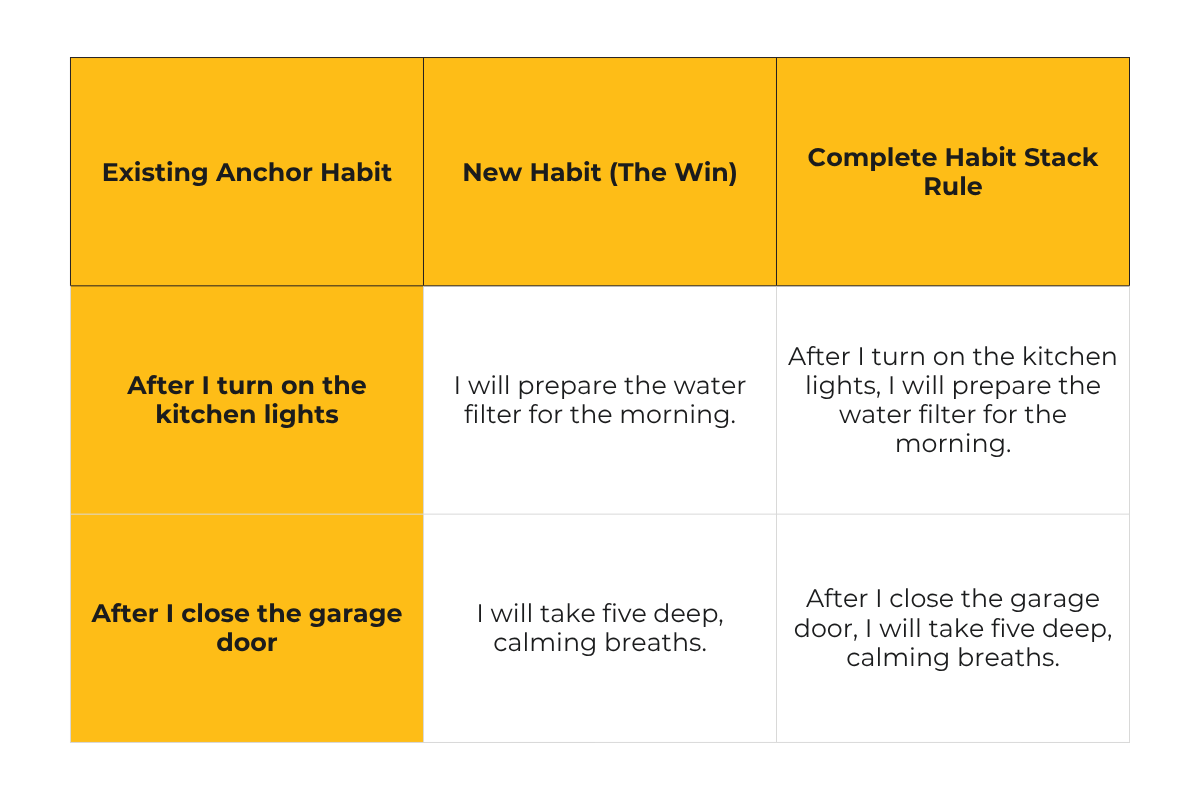
Step 3: Forge the chain (The If… Then… Rule)
Connect your inventory item (the Anchor) to your desired small win (the New Habit). Write it down exactly.
Decide once. Repeat forever. That’s how small habits defeat big fatigue.

