

We are living in the golden age of the “Productivity Scam.”
Every day, we are bombarded with the same seductive promise: If you just find the right app, the right AI prompt, or the right organizational hack, you will finally unlock your potential. It’s a compelling narrative because it feels like progress. Buying a subscription feels like a win. Downloading a new dashboard feels like a breakthrough.
But for most professionals, this is nothing more than “polishing the hammer” while the house is on fire. We are drowning in tools, yet starving for thinking power. We are obsessed with the How (the distractions) because we haven’t mastered the What and the Why (the essentials).
If you want to move the needle in 2026, you don’t need a better software suite. You need a better brain.

1. The 60% Drain: The “Work About Work” Epidemic
The numbers behind our digital overwhelm are staggering. A global study by the software giant Asana, surveying over 10,000 professionals, discovered that we spend roughly 60% of our day on “work about work.”
What does that look like in reality? It’s the friction of switching between 15 open tabs, the endless hunting for a file named “FINAL_v2_edit,” and the performative chasing of status updates. We were hired for high-level thinking, yet we spend the majority of our best hours acting as digital housekeepers for our own tools.
This is the Efficiency Illusion. We look busy, our screens are full, and our notifications are buzzing—but our actual output is stagnant. We have mistaken activity for achievement. We’ve fallen into a trap that Microsoft’s Work Trend Index often highlights: the “digital debt” where the volume of data and communication outpaces our ability to process it.
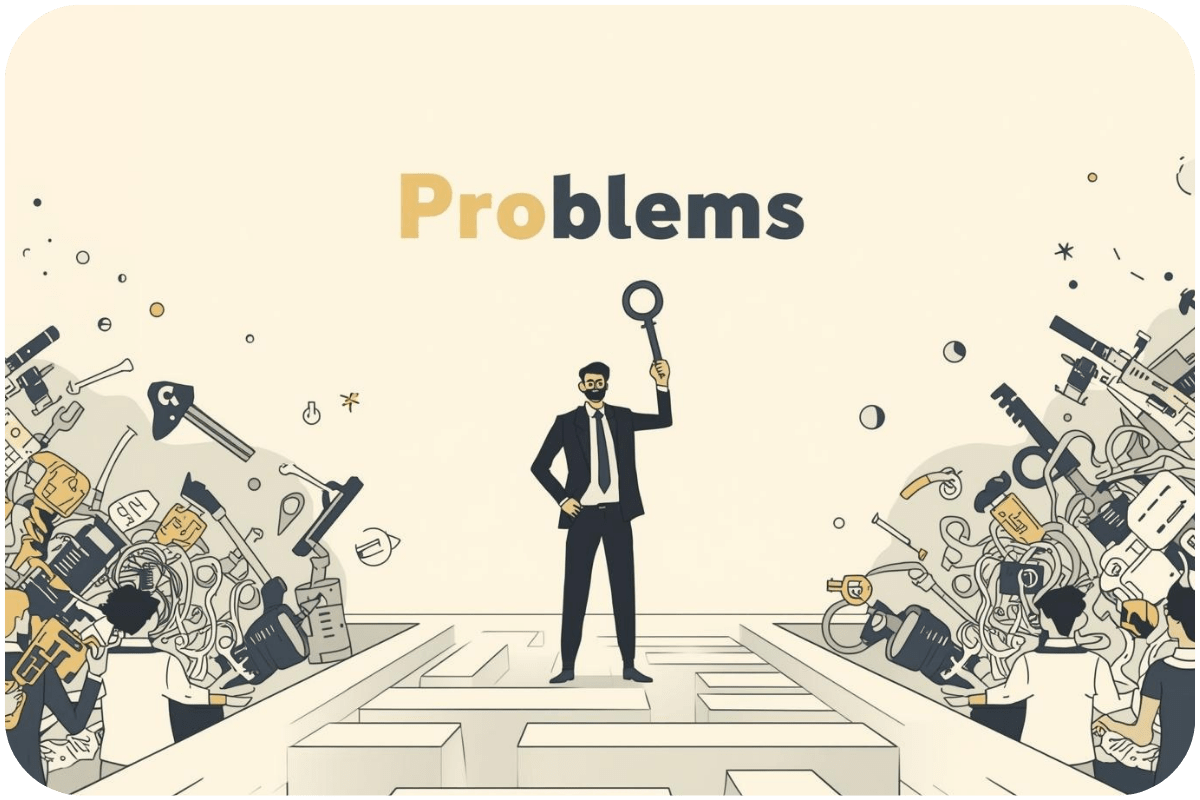
2. The Complexity Scam: Why Subtraction is the Ultimate Leverage
The most effective leaders don’t have “secret” apps. In fact, they usually have fewer tools than everyone else. They understand a fundamental truth: A complicated problem does not require a complicated tool.
We often fall for the “Complexity Scam.” We buy a $500 ergonomic chair instead of fixing our posture. We download a 12th tracking app instead of fixing our focus. We automate a broken process instead of questioning why the process exists at all.
High-performers lead with Mental Models, not software. These models act as “Master Keys,” allowing you to see the underlying structure of a problem before you ever touch a keyboard. To escape the complexity scam, you must master two specific frameworks:
- First Principles Thinking: This is your “B.S. Detector.” Popularized in modern business by Elon Musk, this involves breaking a problem down to its fundamental truths. Stop asking “How do we usually do this?” and start asking “What is the most basic goal we are trying to achieve?”
- The Circle of Control: Based on the work of Stephen Covey, this is your “Energy Saver.” Most professionals burn 80% of their mental fuel worrying about things they can’t change—the economy, their boss’s mood, or a competitor’s move. If it’s outside your circle, it’s a distraction. If it’s inside, it’s your priority.

3. The Map is Not the Territory: A Lesson from Intel
One of the most dangerous traps in modern business is confusing the “Map” (your data, your project board, your spreadsheet) with the “Territory” (the real world). The philosopher Alfred Korzybski famously noted that the map is merely a representation—it is not the reality.
In 1994, Intel faced a crisis that perfectly illustrates this. Their new Pentium chip had a flaw in its division algorithm—the “FDIV bug.” Intel’s engineers looked at their statistical Map and saw that the average user would only encounter an error once every 27,000 years. They told the world the chip was “effectively perfect.”
But in the Territory, “mostly accurate” is the same as “broken.”
The chip used a shortcut for division called the radix-4 SRT algorithm. To save time, it used a “lookup table”—essentially a high-speed math cheat sheet. Out of 1,066 entries, someone forgot five. Just five. That “tiny” error meant that for a scientist or a bridge engineer, the machine was capable of lying. As documented in Intel’s own history, the public backlash was catastrophic.
Intel tried to fix a Trust problem with a Math lesson. They failed because they trusted their data map over the human reality. It wasn’t until CEO Andy Grove performed a Strategic Inversion—asking what a new CEO would do if they were hired to fix the mess today—that they decided to replace every single chip at a cost of $475 million.
The Lesson: If the logic is flawed, the frequency doesn’t matter. If your tool is “99% right” but requires you to double-check everything anyway, it isn’t a tool—it’s a distraction.

4. Overcoming Your “Brain Glitches”
Why do we keep buying the $50 subscription instead of doing the 50 minutes of deep thinking? It’s not laziness; it’s a cognitive “glitch.”
- Anchoring Bias: We see a “Top 10 AI Tools” list and our brain anchors to the idea that more tools = more productivity. We stop asking if we need the tool and start asking which one to buy.
- Confirmation Bias: Once we buy the tool, we ignore the 30 minutes of “maintenance” it requires and only focus on the 2 minutes it saved us. We want to be right about our purchase more than we want to be effective.
According to research from the Decision Lab, these biases act as shortcuts for our brain, but in a high-complexity world, they lead to “tool hoarding.” To fight these, you need the “Model” Defense. A tool has a shelf life; a mental model lasts a lifetime. A tool complicates your process; a model simplifies your decision.
5. The Final Audit: Signal vs. Noise
When you stop being a “Collector of Tools” and start being a “Collector of Models,” your work changes. You stop asking, “What app should I use?” and start asking, “What truth am I missing?”
To reclaim your thinking power today, perform a ruthless audit of your digital toolbox. Pick the tool you spent the most time “managing” last week. Try to do your job tomorrow without it.
- If the work stops, it’s an Essential.
- If the work gets clearer, it was a Distraction.
As the minimalist philosophy of Cal Newport’s Digital Minimalism suggests, you don’t need a better calendar app; you need a better “No.” You don’t need an AI summarizer; you need to stop attending meetings that don’t matter.
Conclusion: Upgrade Your Brain
Stop searching for the “magic bullet” in the App Store. The most powerful software you will ever own is the 3-pound mass between your ears. By mastering mental models like First Principles, the Circle of Control, and Map vs. Territory, you stop being a slave to your notifications and start being the architect of your day.
Ready to start building a better brain? Don’t just follow the map—learn to navigate the territory. Master the frameworks that actually move the needle.Grab the Super Thinking Training Toolbox and the insights from How Smart People Think, Book 1 to separate the signal from the noise once and for all.

